Listen to the article
On Main Street west of downtown Louisville stands a historic marker. It is easy to miss. What is more likely to catch the eye is a costume and novelties store diagonally across the street. If you give directions using the store as a reference point, most people in the area will know where you mean. There is a massive skull propped on the roof and an ancient black hearse parked next to the store. If you were to give the historic marker as a reference, however, you would likely be met with a befuddled expression. But the marker occupies its spot for a reason. The neighborhood was once filled with Irish tenements called Quinn’s Row.
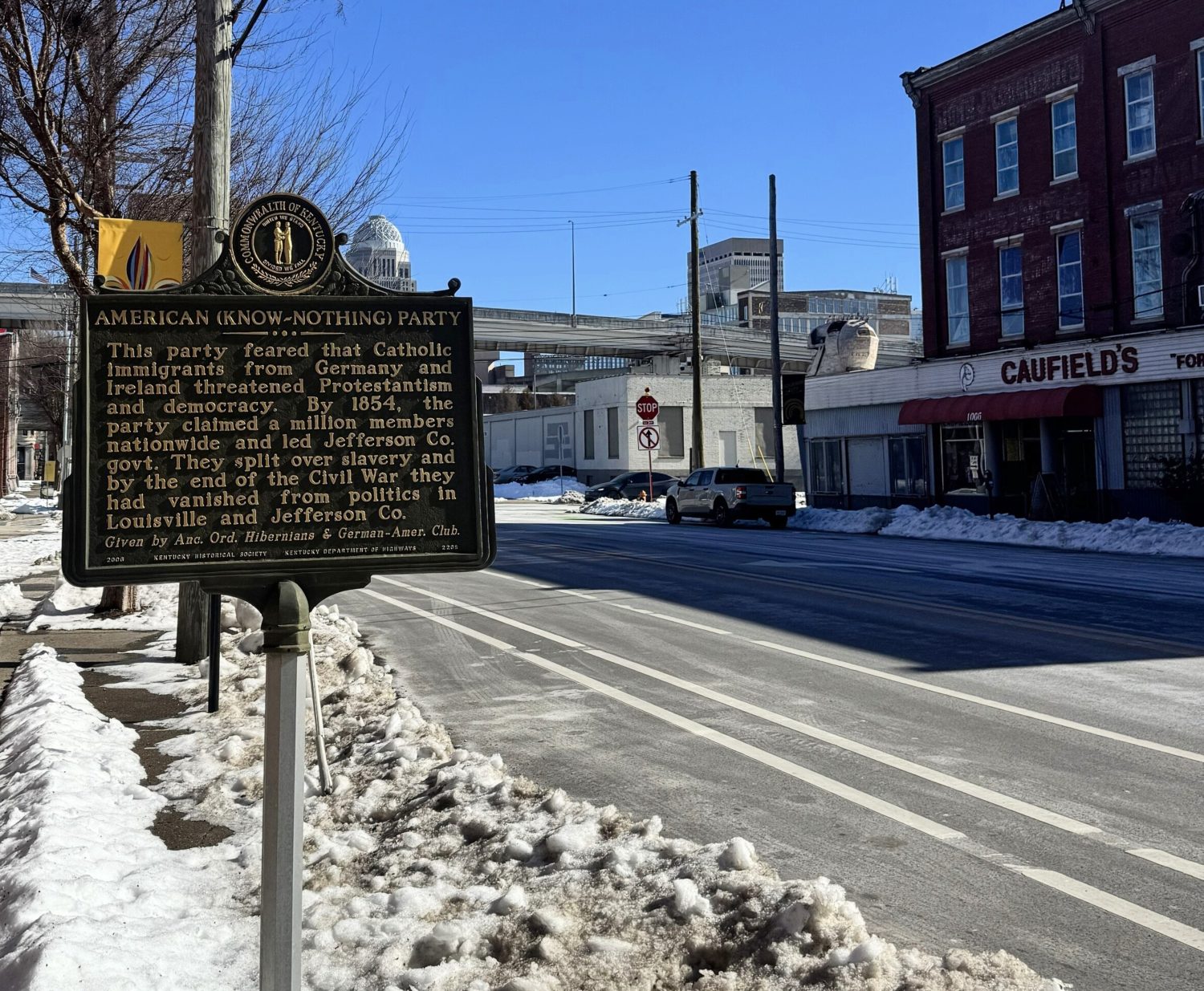
The sign calls attention to Bloody Monday, a day of violence in 1855 by mobs against immigrants and Catholics. An estimated 22 people lost their lives. Some contemporary estimates gave a much higher death toll. One of the deaths was Patrick Quinn, a 57-year native of County Derry, Ireland who had become a successful property owner in Louisville. He owned 12 houses that were destroyed by fire that day. Later, his remains were pulled from the ashes of one of his buildings. He had been shot and beaten. Other bodies, some never identified, were also found in the Quinn’s Row rubble. Some were the victims of gunshots, and others died in fires. The events that led to the deaths are nearly a perfect reflection of what we see today.
Using fear as a weapon.
August 6, 1855 was election day. The offices of Kentucky Governor, U. S. Congress, and County Sheriff were among the elective positions up for grabs. The American Party, whose adherents were also known as Nativists and Know-Nothings, had a strong base in Louisville and across the state. Know-Nothings got their moniker in the 1840s–their early days–when their organized antipathy toward immigrants was yet to become fully formed. If asked about their organization, though, the nativists would say they knew nothing about it. By 1855, they felt safe enough to express their bigotry publicly. Many Know-Nothings were refugees from the crumbling Whig Party; they wanted to form a party less focused on slavery and more on the rights of the American-born working class. Their political adversary was the Democratic Party. Neither political party was particularly enlightened, but the Democrats were more than willing to scoop up the support of immigrants to win elective offices. In Louisville, that meant Germans and Irish. Conversely, those same immigrants were the American Party’s bête noire. The Know-Nothings claimed that immigrants threatened the jobs and futures of native workers. To their thinking, immigrants, no matter how long they had lived in Louisville, were not American.
The immigrant population was not completely without fault leading up to the election. Some Germans had formed their own secretive group called Sag Nichts, or “Say Nothings,” which was said to be Anti-American. Neither the nativists nor the Sag Nichts trusted the other. One group knew nothing, the other said nothing, and both would resort to violence should they feel it necessary.
Wielding the power of the press.
The Louisville Daily Journal, behind its editor George Prentice, served as the primary mouthpiece for the Known-Nothings. When the Whigs still had some power in Louisville, Prentice courted immigrants to support the party. In 1855, however, his feelings seemed to have changed. He incessantly beat the anti-immigrant drum in the days leading up to the election. The Germans and Irish were bad enough, Prentice wrote, but they were only the start. The election was a chance to turn back the foreign tide. Four days before the election, he wrote, “We already see inclinations that, as we approach the (Pacific) Ocean, the Chinese, the Siamese, the Japanese, and other similar barbarous people will precipitate themselves upon our shores and become incorporated with our population.”
Nativist plans to disrupt election day were no secret. The Louisville Daily Courier–a key rival to the Journal–reported on the Friday before the election that Known-Nothings were “determined to take possession” of polling places in the First, Second, and Eighth Wards as soon as they opened that Monday. Those wards had significant immigrant populations. (The Courier and Journal merged in 1868.)
Limiting opportunities to vote.
Like many cities, Louisville had seen a huge influx of immigrants in the 1840s and 1850s.The total Louisville White population in 1850 was more than 43,000. Two of every seven Whites were foreign-born. Though its population was growing rapidly, the Kentucky Constitution of 1850 dictated that election periods in the state be reduced to one day rather than the previous three-day period. Among the reasons was an effort to reduce the potential for corruption and bribery, including some men travelling to vote at multiple locations across the state to help their party win. In 1851, the state General Assembly further established voting rules including allowing election officials to request naturalization documents from immigrants. Louisville’s City Council could have at least expanded the number of polling places to reduce voting bottlenecks, but they could not come to an agreement on the issue by the 1855 election. Even George Prentice of the Journal wrote that the shortage of polling places would cause issues.
Leveraging religious intolerance.
Perhaps no group of Louisville citizens withstood excoriation from nativists more so than those who were both immigrants and Catholics. Many Know-Nothings, who were majority Protestant, believed Catholics were akin to an insidious cabal, putting the pope above the Constitution. The Journal paper stirred the pot.
Five days before the election: Prentice cited rumors that Pope Pius IX would release Catholics from their allegiance to the United States when casting their ballots. The editor asked rhetorically if Catholics were fit to vote or hold office if “the Pope of Rome, an inflated Italian despot, who keeps people kissing his toes all day, cannot at any moment release them?”
Four days before the election: Prentice called the Democratic Party the un-American party. “Take away from it the foreigners and Catholics and there is nothing left but a few well-paid office holders left over from the (President Franklin) Pierce administration,” he said. “There is no more comparison between this bogus party and the old Democratic party than between a soulless dead body, given up to corruption and decay…”
Three days before the election: Should the Democrats win at the polls, Prentice wrote, “the bitterness of the foreign element would burst forth in double volume, and the Catholics, now crouching with subdued but rankling venom, awaiting our subjugation by their political allies, would spring upon us with the fury of the tiger.”
Not until election day arrived did Prentice somewhat soften his tone. “We did not feel disposed to exclude all foreign-born persons and Roman Catholics from office, for we had seen manifestations of patriotism on the part of members of both those classes…” Yet on the following page of the same issue, he wrote, “Americans, are you all ready? We think we hear you shout ‘Ready!’ Well, fire! and may heaven have mercy on the foe.”
Igniting public violence.
John Bauman was a 49-year-old cabinet maker born in the German-speaking part of Switzerland. At eight o’clock that Monday morning, he went to his polling place at a fire station in the city’s First Ward. Many native German speakers lived there on the east side of the city. There was also a small population of Irish, though more of them lived in the Eighth Ward on the west end of town. In 1855, the First Ward stretched from the Irish Hill neighborhood down to the Ohio River. Today along the river, Louisville’s soccer stadium and accompanying parking lots occupy spaces where there were once houses on extinct streets like Marion and Lloyd.
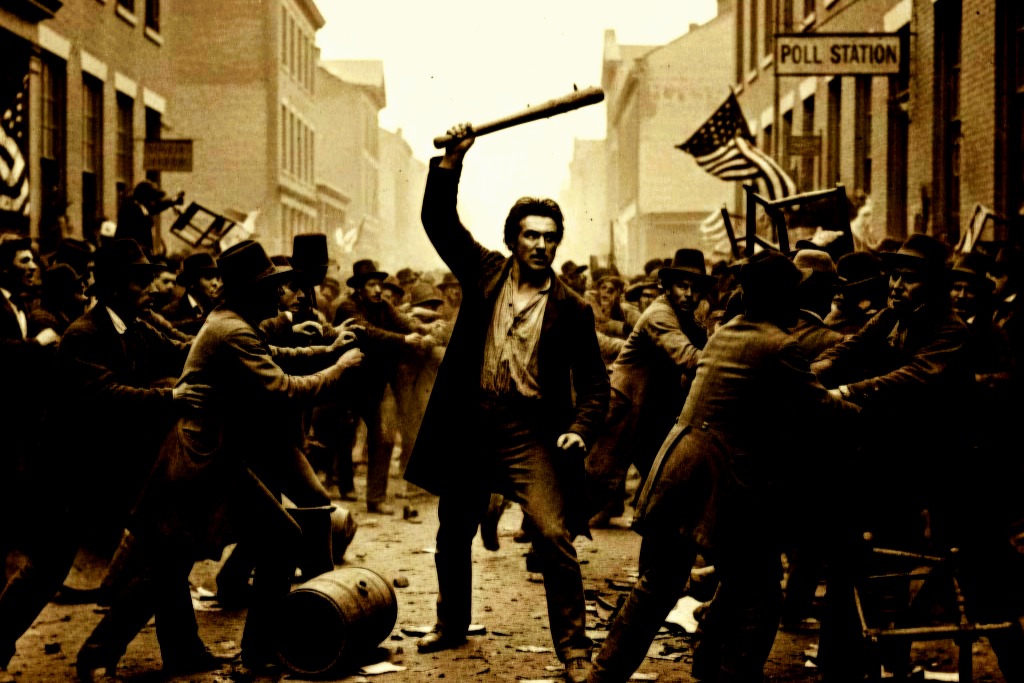
When Bauman arrived at the polling place, he saw a large crowd at the entrance. Among them were men armed with lead-spiked clubs and fueled by liquor. The men were winnowing the crowd. Only those assumed to support the Known-Nothing slate–”Americans”– were allowed to enter. Some were hoisted over the heads of the crowd and carried forward. “I saw several men strike a German on the head with a stick,” Bauman said. He convinced them to stop, but fifteen minutes later, he “saw some men I thought to be Know-Nothings, with sticks charged with lead, drag a foreigner out of the crowd and struck him on the head until he began to run.” Bauman said the attackers caught up with the man and resumed beating him. When Bauman again tried to intercede, one of the men grabbed him from behind while another hit him on the head with a club.
Another witness, when giving a deposition the following month, said he had seen several immigrants beaten away from the polls, including a “German struck in the mouth with brass knuckles.” The witness, George Craig, said none of the immigrants at the polls “had given any provocation, either by words, gestures, or in any way I could discover.” Other witnesses in the First Ward described seeing “a German struck on the head with a stick,” and “as many as 25 Germans knocked down with clubs and slug shots.” At Jackson and Green streets–now part of a hospital district–a witness “saw the crowd pursuing three Germans, throwing stones at them, and crying ‘kill the damn Dutch sons of bitches.’”
Two churches, the Cathedral of the Assumption and St. Martin of Tours, were threatened by a mob of arsonists. They were reacting to rumors that each church held a secret cache of weapons. Louisville mayor John Barbee, who was a member of the Known-Nothings, personally inspected the churches. Finding no arsenal at either location, he calmed the mob. Still, a Reverend Karl Boeswald, a native Bavarian, was stoned while on his way to visit a dying parishioner. He died three months later when an abscess formed on one of his injuries. Mayor Barbee would later express regret for joining the Know-Nothing party.
Blaming the victims.
Nativists were not the sole source of violence. Armed Irish men reportedly shot back at their attackers from building windows. Natives were among the dead. Yet, the Known Nothings were quick to say that immigrants and Catholics ignited the violent events of that day. According to the Journal, the American Party’s opponents went to the polls early to create disturbances to make excuses for their expected small vote totals. “The Americans resolved to prevent them from doing this, by preserving perfect order at the voting places; and this they did,” the Journal said. “When the Sag-Nichts found they were foiled and could not get up a disturbance at the polls, we suppose they resorted to the dreadful expedient of firing on the people passing in the streets.”
A committee within the city council investigated Bloody Monday violence and put the blame almost solely on the immigrant population. For example, Quinn’s Row on west Main Street was a “complete armory” occupied by a “den of assassins”. According to the committee, Patrick Quinn and others started storing guns and ammunition three weeks prior to the election. When the day arrived, “Americans were shot down without provocation.” The “potentates of Rome” were also to blame, said to the committee’s report. In the First Ward east of the city’s center, “murderous attacks were made by foreign Papists on unsuspecting Americans, and doubtless at the instigation of those higher and more skilled in the dark deeds of Catholicism.”
The aftermath.
The American Party swept statewide offices including Governor, Lieutenant Governor, and Attorney General. The winning margin for governor in Louisville–58% American to 42% Democrat–was like the other races. Margins were even wider out in the county. On the eve of the 150th anniversary of Bloody Monday, Peter Smith wrote in the Louisville Courier-Journal that, though some historians have disagreed, others have speculated “the riots caused many immigrants to flee or avoid Louisville, sapping its economic strength and allowing St. Louis and Cincinnati to eclipse it.”
No one was prosecuted for the events of Bloody Monday. Coroner’s Inquest findings were typically brief. An inquest was held on the same day as the death of Dennis Diordan, about 34, who ran a feed store on Quinn’s Row. He was shot in the chest and thigh and died in the early morning of August 8th. In its verdict, the inquest said Diordan “came to his death from the hands of unknown persons.”
The American Party had a short lifespan. Its 1856 candidate, ex-president and former Whig Willard Fillmore, received eight electoral votes, carrying only Maryland. Ten years following Bloody Monday, Louisville elected its first foreign-born mayor. Phillip Tomppert, a native of Germany, won his first election on April 1, 1865, eight days before Lee’s surrender to Grant at Appomattox. Tomppert may have been helped by his expressed support for ending the war yet continuing slavery.
Today, Germantown and Schnitzelburg are popular residential, shopping, and restaurant neighborhoods in Louisville. The annual St. Patrick’s parade draws tens of thousands of spectators, if the weather cooperates. Like many cities of its size, Louisville remains segregated along racial lines. Beginning in the late 20th century, however, the city saw a large influx of foreign-born residents from Latin America, Sub-Saharan Africa, as well as Southern and Eastern Asia. According to a report by the Urban Institute, Louisville’s foreign-born population was “unusual” because a comparatively large share of immigrants were refugees or asylum seekers.
Those figures began to drop in recent years concurrent with cuts in resettlement funding and other challenges faced by refugee programs.
__________________________________________________
Bibliography
Quinn Deusner, Charles E. The Know Nothing Riots in Louisville. The Register of the Kentucky Historical Society, Vol. 61, No. 2. April, 1963.
KNs Know-Nothing Party. Link. https://www.britannica.com/topic/Know-Nothing-party
Congleton, Betty Carolyn. George D. Prentice and Blood Monday: A Reappraisal. The Register of the Kentucky Historical Society, Vol. 63, No. 3, July, 1965.
(1855, August 2) Important Consideration – the Naturalization Laws. Louisville Journal.
(1855, August 3) A Desperate Game. Louisville Daily Courier.
1850 U.S. decennial Census.
(1855, August 1, 2, 3) Louisville Journal.
(1855, August 6. That Conversation. Louisville Journal.
(1855, September 22) History of the Outrages at the Elections of this City. Louisville Weekly Democrat
Harper, Leslie Ann. Lethal Language: The Rhetoric of George Prentice and Louisville’s Bloody Monday. Ohio Valley History. The Filson Historical Society and Cincinnati Museum Center. Volume 11, Number 3, Fall 2011
(1855, August 13) The Riots – Their Foreign Origin. Louisville Journal.
(August 20, 1855) Board Common Council Minutes Thursday August 16, 1855. Louisville Daily Courier.
(1855, August 7). Kentucky Elections. Louisville Journal.
(2005, July 30) Recalling Bloody Monday. The Louisville Courier-Journal.
Kleber, John E. Philip Tomppert. The Encyclopedia of Louisville. University Press of Kentucky, 2001.
(1855, August 9) More Victims. Louisville Courier.
A Profile of the Foreign-Born in the Louisville Metropolitan Area by the Urban Institute
 Home
Home 
Leave a comment