Listen to the article
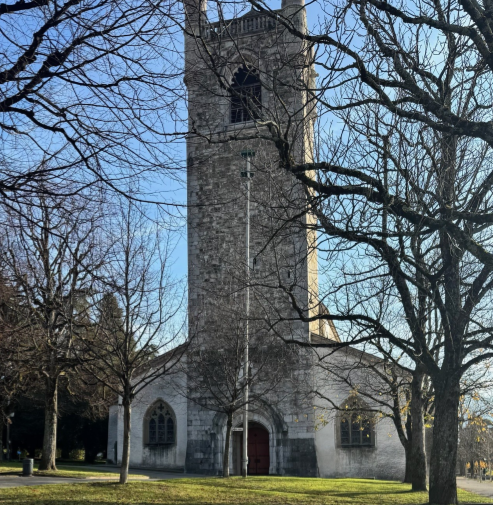
Église Saint-Martin, an Evangelical Reformed church, sits up a hill just a few blocks from Lake Geneva in Vevey, Switzerland. The history of the church goes back a thousand years. If you don’t have a deep knowledge of the early years of progressive rock, you may not know that Rick Wakeman of Yes played the church organ on a few songs for the band’s 1977 album Going for the One. But then, if you’re not a fan of prog rock, you may not know who Rick Wakeman is either. Or Yes.
Victor Hugo, who authored Les Misérables and the Hunchback of Notre Dame, lived too early to be impressed by that bit of church trivia, but he did visit there during his self-imposed exile from France while Napoleon III held power. In a letter to a friend, he expressed his admiration for the church and drew a sketch of it. Hugo also visited the graves of two other expatriates who were buried in the cemetery just up the hill from the church.
More on Hugo’s trip to Switzerland.
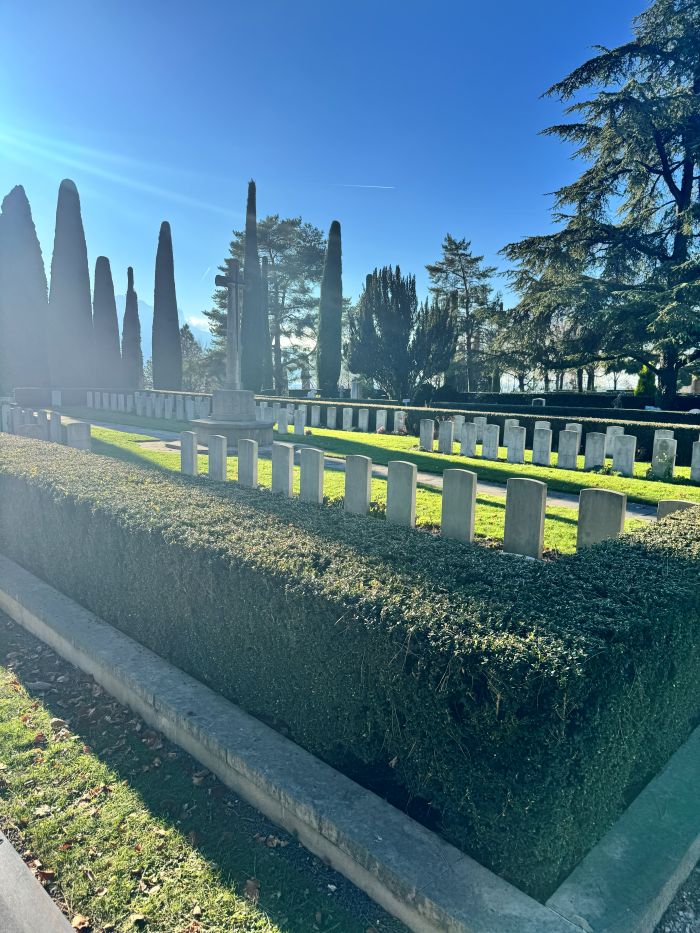
What came later to the cemetery is more curious. Vevey lies near the French border and is in the French-speaking part of Switzerland. However, amid the tombstones mostly with French surnames is a section of hallowed ground with English names and text on each marker. At the center of the graveyard and bordered by neatly trimmed hedge are the burial places of 88 British Commonwealth soldiers who died during the first and second World Wars. They represent the countries of New Zealand, Australia, Canada, South Africa, India, Scotland, Ireland, and England. For non-Swiss visitors especially, it can be jarring to come upon the incongruous sight of foreign soldier tombstones in a militarily neutral country distant from any battlefield and far from their families. Yet, Swiss neutrality is why this small patch of grass and dirt is the final resting place of those soldiers.
In World War I, Switzerland agreed to take in 68,000 German, French, and British prisoners of war from overflowing prisoner camps elsewhere in Europe. Even British soldiers convalescing in England went to Switzerland where their chances of recuperating in the mountain air were better. The transferred prisoners had to meet certain criteria. For one, they had to be so severely wounded or ill that they were unlikely to return to combat. The POWs experienced dramatically better living conditions in Swiss mountain villages such as Chateau d’Oex in the same canton as Vevey. The lake resort area of Interlaken was another destination.
More on Commonwealth soldier transfers to Switzerland.
Private Alfred Stanaway of the 1st Auckland Battalion was a laborer in civilian life in New Zealand. After being wounded in an arm and leg, he was captured and imprisoned in Germany before his transfer to Switzerland. Accommodation and medical care there were much better for POWs; Stanaway appears to have recuperated, even participating in a POW aquatic club. However, the relative safety of Switzerland was not enough to ensure his survival. The “Spanish Flu” pandemic of 1918 took the lives of an estimated 50 million people across the globe. Stanaway died of influenza and pneumonia on March 11, 1918, leaving behind a widow in New Zealand.
More on the Spanish Flu outbreak.
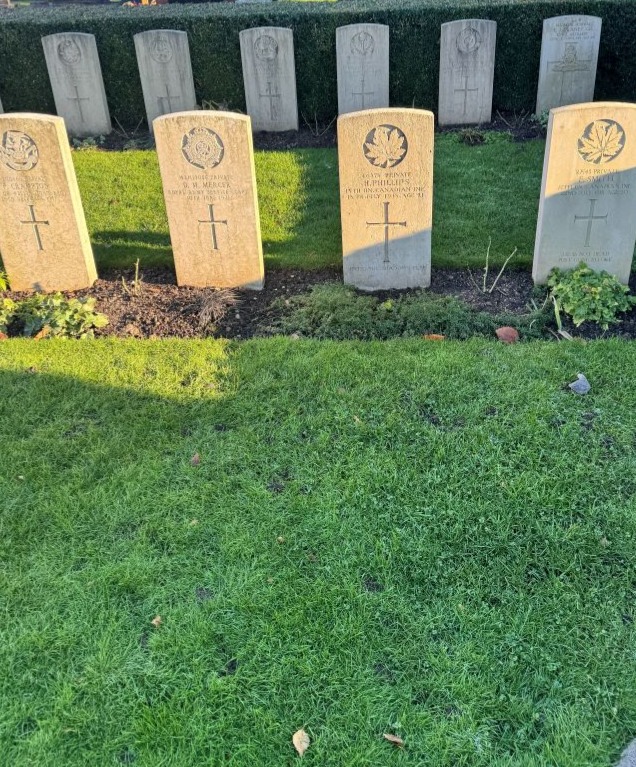
Another soldier from the First World War buried in Vevey was Lance Corporal Charles Frederick Bromfield, 24, of the Australian Imperial Force. He had been reported missing in action on the Western Front, most likely in France. First imprisoned in Germany, he was transferred to Interlaken. He died of double pneumonia on November 7, 1918, just four days before the Armistice.
Left: World War I graves
The cemetery received more Commonwealth burials during the Second World War. However, those graves are of POW escapees and men who died in battle. After being captured in late December 1941 in northern Africa, Cyril “Lofty” Richardson of England was imprisoned in northern Italy. He escaped in September 1943, crossing the border into Switzerland where he soon died of pneumonia and pleurisy. Richardson, 26, was part of the Coldstream Guard’s Long Range Desert Group.
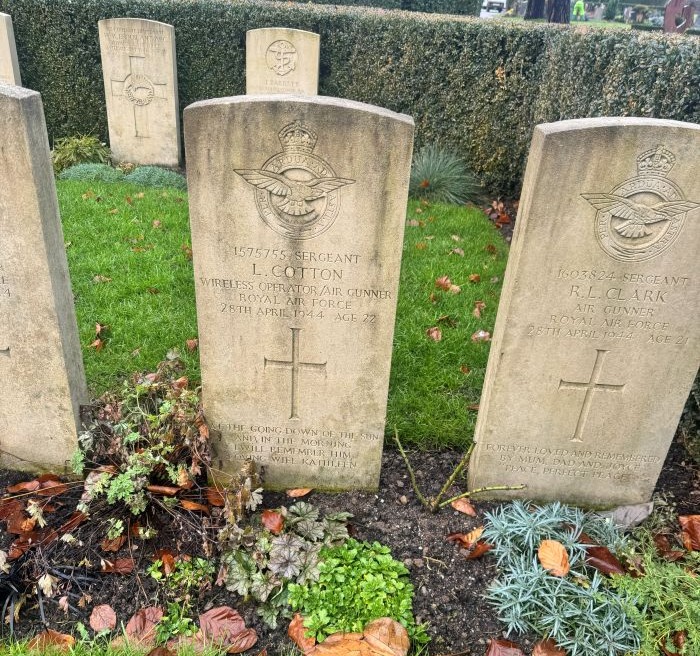
Five tombstones side by side in the cemetery carry the same dates: April 28, 1944. They were crew members of a Royal Air Force bomber that crashed early that morning near Hämikon, Switzerland. The village was 60 km south of the German border.
Left: 166th Squadron crew members
The Lancaster heavy bomber, from the 166th Squadron, was one of more than 300 bombers that struck Friedrichshafen, Germany late the night of April 27.. The town was home to industrial companies supporting the war, including a factory co-owned by the inventor of the Zeppelin airship. The factory was a key target the night of the bombing raid because it produced gearboxes for tanks. According to a report that appeared in London’s Daily Telegraph four days following the raid, the town lay in ruins. More than one thousand tons of bombs had rearranged the landscape.
Though the mission was successful, not all bombers returned to their bases in England. Another bomber from the 166th squadron made it to France before crashing, killing all aboard. The plane that crashed in Switzerland was either hit by a German fighter plane responding to the attack, or it strayed into Swiss air space and was brought down by air defense guards. Two of the crew were able to walk away from the crash. They were imprisoned by the Swiss before reportedly escaping and returning to England.
The crew members buried next to one another at the Vevey cemetery are Pilot Robert Ridley, Flight Engineer John Eaton, Sergeant Leslie Cotton, Sergeant Ross Clark, and Sergeant Allan Weir. Except for Eaton, whose age is not recorded, all the dead crewmen were in their early twenties.
Pilot Ridley grew up on the banks of Lake Ontario. He was attending college in Toronto before he enlisted in the Royal Canadian Air Force. According to witnesses, he steered the damaged bomber away from the village as it plummeted.
That the Lancaster bomber may have been shot down by Swiss defense forces indicates how seriously Switzerland took the protection of its neutrality. Belgium, also neutral though invaded in both World Wars, was an example of how combatants could overlook a country’s non-belligerence if it suited their greater goals.
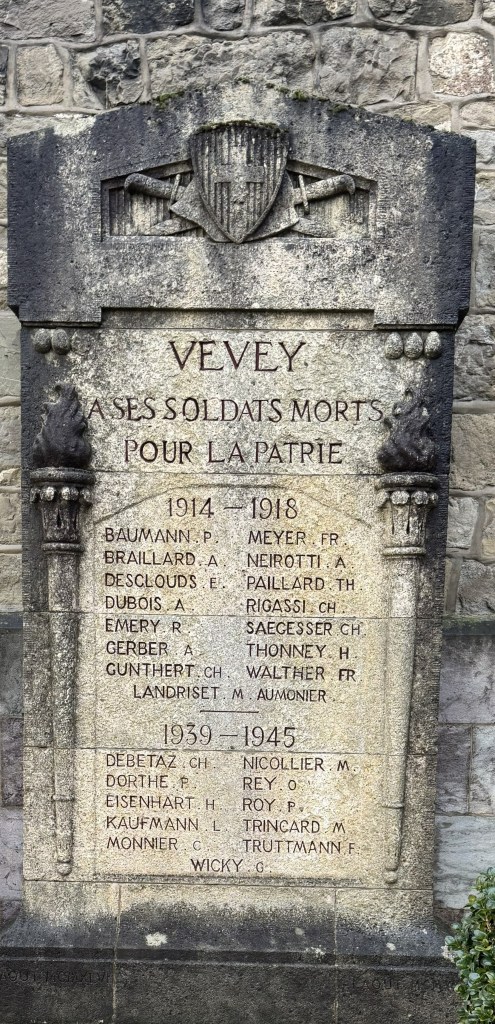
A marker on the east side of Église Saint-Martin commemorates Swiss citizens who died protecting their country. The monument displays the names of fifteen people from World War I and eleven from World War II. The inscription above the names reads “Vevey to its soldiers who died for the homeland.” Nearly 3,000 Swiss soldiers died during World War I. The Spanish Flu was the main factor, killing more than half of them. In the second World War, 100 civilian deaths—and no soldier deaths—were reported.
The sight of the graves of foreign servicemen so far from their homes and families is sorrowful. On a recent visit, however, a small Canadian flag had not long before been placed next to the tombstone of a soldier from that country. It was a small bit of proof that the soldiers buried in Vevey have not been forgotten. Their names are engraved on monuments throughout Switzerland and back home where their fellow citizens can honor them.
In Australia the names of soldiers like Charles Bromfield are regularly projected on the exterior of the country’s War Memorial. Further, relatives who were not yet born when these soldiers and airmen died, keep their stories alive so that their sacrifices will not be lost to time.
 Home
Home 
Leave a comment